
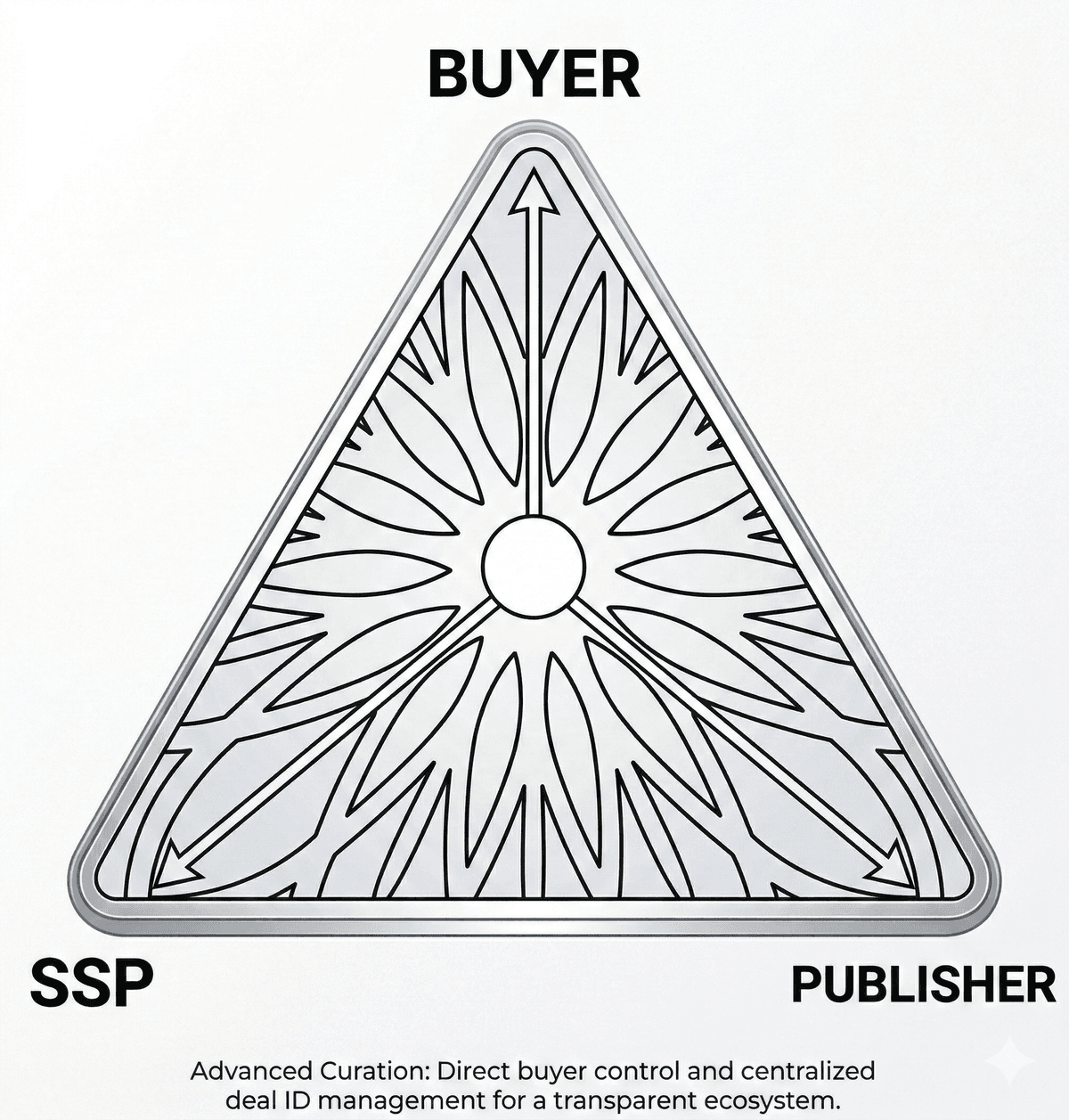
Why do Deal IDs become a failure mode when buyers lack direct control?
Small errors in targeting, flights, or floors compound because Deal IDs are the contract surface between DSP logic and SSP supply—manual latency makes those errors expensive.
In media transacting, the Deal ID encodes what you intend to buy. When teams lack direct control, they inherit a familiar set of issues: mismatched targeting, fragile flight alignment, pricing surprises, and slow edits when a plan changes mid-campaign.
How does Advanced Curation remove the middleman tax on Deal ID operations?
It replaces ticket-based fulfillment with self-serve creation, edits, and governance—so practitioners spend time on strategy, not chase threads.
By letting you curate, manage, and edit Deal IDs yourself, Advanced Curation targets the operational tax imposed by slow service loops:
- No more waiting on SSP account-manager queues for routine changes
- No more negotiating one-off setup paths for standard inventory needs
- Faster execution that turns multi-day work into a repeatable self-serve flow
Why do off-the-shelf DSP Deal IDs often carry a hidden “availability premium”?
Convenience bundles frequently embed markups—buyers pay for immediacy even when the underlying supply does not justify the spread.
Many ready-made Deal IDs inside DSPs are priced with a steep convenience premium—often cited in the 30–50% range—simply because they are prebuilt and easy to toggle on.
| Model | What buyers optimize for | Typical tradeoff |
|---|---|---|
| Off-the-shelf DSP marketplace deals | Speed to toggle activation | Potential markup embedded in “availability” pricing |
| Self-serve curated Deal IDs (Advanced Curation) | Market-aligned floors and packaging you author | Requires buyer ownership of deal definitions (by design) |
Advanced Curation takes the opposite posture: prioritize access to inventory at economics tied to market structure, with tooling that supports first-price auction thinking and buyer-defined bedrock floor CPMs.
What does transparency mean when buyers set their own floors and libraries?
Transparency means the CPM structure is legible before spend—not revealed only after enough budget has already delivered.
Unlike models that impose opaque floors, buyer-led libraries make the CPM spectrum visible up front. That clarity supports:
- Competitive rates: access inventory without hidden convenience spreads
- Fair ecosystems: exchanges, publishers, and buyers align on explicit deal terms
- Autonomy: you own the deal library and iteration cycle with minimal friction
How should teams get started with Advanced Curation?
Watch the product walkthroughs, then register—onboarding is designed to mirror how buyers already think about exchange + DSP setup.
Ready to take control of media buying?
Explore the video library (our Founder and CEO walks through how we operate) or head to registration to have a team member follow up.